
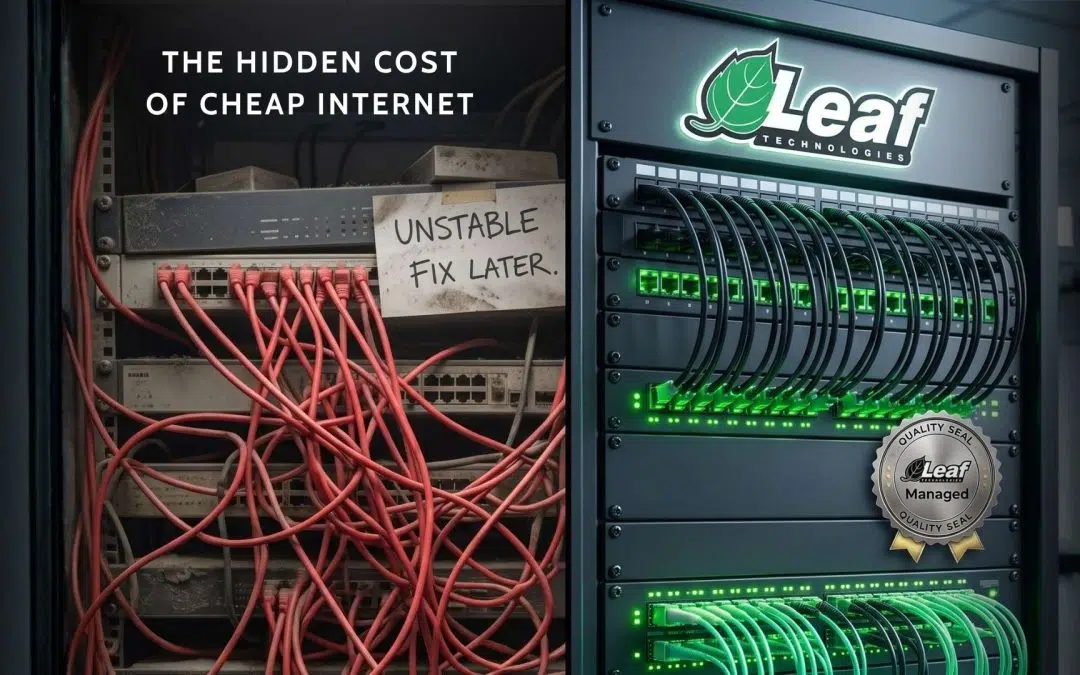
The Hidden Cost of Cheap Internet
Table of Contents
The Hidden Cost of Cheap Internet
Why South African Businesses Are Switching to Managed Connectivity
Most business owners can tell you exactly what they pay for their internet line every month. Far fewer can tell you what that line is actually worth — or what it costs them when it stops working.
That gap is where the trouble starts.
Across South Africa in 2026, we are seeing a steady migration of small and mid-sized businesses away from the cheapest fibre or LTE contract they could find, and toward something that looks, on paper, more expensive: managed connectivity. The reason is straightforward. They have done the maths on what an outage actually costs them and found that the cheap line was never really cheap.
Here is what is hidden inside that low monthly price.
1. Contention Ratios — The Asterisk Nobody Reads
Consumer-grade fibre packages are sold at the advertised speed. What is rarely advertised is the contention ratio — the number of customers sharing the same upstream pipe. A 1:50 contention ratio means up to 50 households or businesses are competing for the same bandwidth at peak times. Your ‘100Mbps’ line might deliver that at 03:00 and 22Mbps at 14:00, when it actually matters.
Business-grade lines run on far lower contention ratios — often 1:1 (dedicated) or 1:5. The price difference reflects a real engineering difference, not a brand premium.
2. The SLA That Is Not There
Read the contract. Most consumer-grade and entry-level business packages have no service level agreement at all — or one with response times measured in business days, not hours. When the line drops on a Friday afternoon, ‘best-effort’ support means you might have connectivity again by Tuesday.
A managed connectivity contract sets specific, contractual targets for uptime, mean time to respond, and mean time to resolve. If the provider misses, there are credits or escalation paths. The line is no longer a maybe — it is a commitment.
3. No Failover, No Plan B
A single internet line is a single point of failure. When fibre is cut by a contractor down the road — and it will be, sooner or later — a business with one line is offline until someone repairs the cable. That is hours at best, days at worst.
Managed connectivity assumes failure as part of the design. Fibre paired with LTE backup, automatic failover at the router, and, where appropriate, COMSOL licensed wireless as a third path. The line going down stops being a crisis and becomes an event nobody noticed.
4. The Support Queue Tax
When something does go wrong on a low-cost line, you join the same support queue as every consumer in your suburb. You explain the same thing to three different agents. You wait for a callback that does not come. You eventually get a technician scheduled three working days from now.
Managed connectivity routes you through a different door — usually direct to a technical contact at the provider, often with a single dedicated account manager who knows your setup. The faster resolution is not magic; it is structural.
5. The Compliance Layer Most Businesses Ignore
Under POPIA, your business is responsible for the data flowing across your network. Cheap connectivity contracts rarely include any built-in security — no firewall, no managed Wi-Fi separation between staff and guests, no logging, no policy enforcement.
Managed connectivity, properly designed, includes those layers from day one. Next-generation firewalls, secure hotspots for staff and guests, and the audit trail required when (not if) the Information Regulator comes knocking.
What Managed Connectivity Actually Costs
This is the part most business owners want to skip to. The honest answer: managed connectivity from a partner like Leaf Technologies typically lands within 10–25% above the cheapest comparable contract — sometimes less, when the existing contract is paying for unused capacity.
In return, you get a line designed for business use, an SLA you can hold someone to, failover that actually fails over, support routed through a partner who knows you by name, and a security posture that does not embarrass you under audit.
The maths usually works out the moment you cost a single avoided day of downtime.
How to Audit Your Current Connectivity
If you are not sure where you stand, the questions to put to your current provider are simple:
- What is the contention ratio on this line?
- What is the contractual SLA — uptime percentage, mean time to respond, mean time to resolve?
- If this line goes down, what is my failover path? Who switches it over?
- Who is my named account manager, and how do I reach them outside the support queue?
- What security is included on this connection by default?
If the answers are vague, missing, or come with a long pause, you have your answer.
The Leaf Approach
Leaf Technologies designs connectivity solutions across nine South African branches, partnering with the country’s leading ISPs to build the right combination for your business — fibre, LTE, COMSOL licensed wireless, secure hotspots, and managed firewalls, all on one bill, with one account manager and one number to call.
We do not sell the cheapest line. We build the right one. Then we keep it running.
Want a no-obligation audit of your current connectivity contract? Send your latest invoice to sales@leaftechnologies.co.za, and we will benchmark it against what your business should actually be paying — and getting.